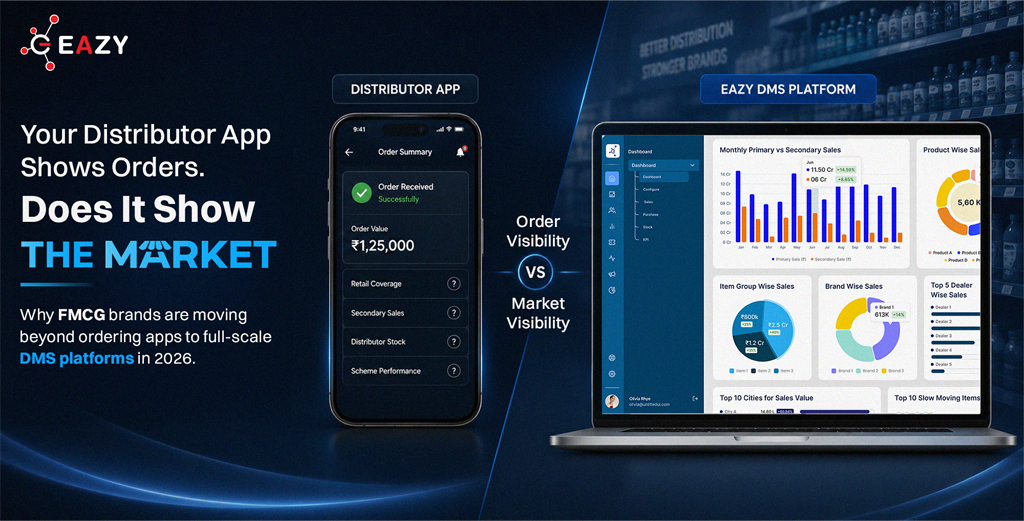
Distributor App vs DMS: Which One Do FMCG Brands Need in 2026?
Reading Time: 6 Min Read | Published: 2nd July, 2026
Key Highlights (What you’ll learn)
- Difference between a DMS and a distributor ordering app
- Why FMCG brands are moving beyond order-taking apps
- Hidden visibility gaps most distributor apps create
- When a distributor app is enough
- When a growing FMCG company needs DMS
A surprising number of FMCG brands believe they have digitised distribution because distributors can place orders through an app. Well, most FMCG brands discover the gap too late; when a distributor shows strong order numbers but half their retail outlets haven’t been serviced in three weeks. The distributor app showed the order but it didn’t show the problem.
That’s the difference between order visibility and distribution visibility and in 2026, as retail channels fragment and distributor networks scale, that gap is costing FMCG brands market share they don’t even know they’re losing.
This guide breaks down exactly what separates a distributor ordering app from a Distribution Management System (DMS) and helps you identify which one your business actually needs right now.
What Is a Distributor Ordering App?
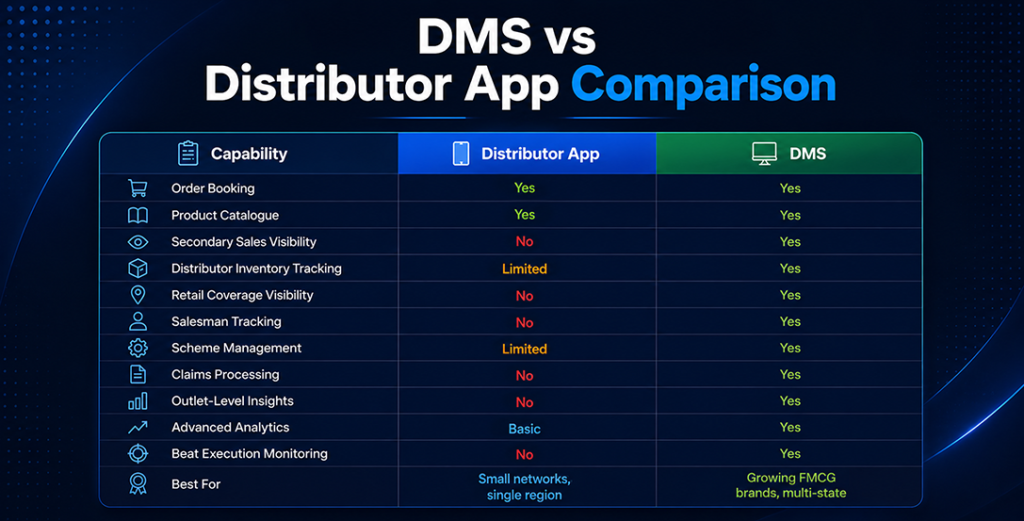
A distributor ordering app is primarily designed to simplify order placement between distributors and manufacturers. Typical features include product catalogue, order booking, outstanding tracking, invoice access, payment visibility, and order history.
For smaller businesses operating in a single region with a limited distributor network, this may be sufficient. However, distributor apps almost always stop once the order is placed. They rarely provide visibility into what happens next, whether products reached retail shelves, which outlets were covered, or how trade schemes actually performed.
Definition: A distributor ordering app records transactions between a manufacturer and their distributors. It answers the question: “Was the order placed?” It does not answer: “Is the market being served?”
What Is a DMS?
A Distribution Management System (DMS) helps FMCG companies manage and monitor their entire distribution ecosystem. Beyond order capture, a DMS provides:
- Secondary sales visibility
- Distributor stock monitoring
- Retail outlet coverage tracking
- Scheme management
- Claims management
- Salesman productivity tracking
- Beat execution visibility
- Market intelligence
- Real-time reporting
The goal is not simply to record transactions but to improve distribution performance.
Definition: A Distribution Management System (DMS) is software that enables FMCG brands to monitor secondary sales, distributor inventory, retail outlet coverage, field execution, and scheme performance in real time, across their entire distribution network.
DMS vs Distributor App Comparison
Still not sure which bucket you’re in? Answer 5 quick questions and find out where your distribution has blind spots.
Why FMCG Brands Are Moving Beyond Distributor Apps
Here’s the reality: India’s FMCG growth has moved to Tier 2 and Tier 3 cities. According to BCG, nearly 600 such cities already account for 36% of India’s FMCG consumption and NielsenIQ confirms rural volume growth has outpaced urban markets for six consecutive quarters. The demand has shifted, the distribution complexity has multiplied but visibility hasn’t followed.
Go beyond Mumbai, Delhi, Bengaluru to Nagpur, Rajkot, Siliguri, Coimbatore, and the picture changes entirely. Distributors operate on WhatsApp, secondary sales are reported, not tracked, and schemes are assumed to have reached retailers. Nobody knows what’s happening at the outlet level until the Friday Excel report arrives, four days late and already outdated. A distributor app doesn’t fix this, it only digitises the order, which was never the hard part. That’s why brands operating across states and tiers are moving to DMS. The most common reasons:
- Secondary Sales Visibility: Knowing what distributors order is useful. Knowing what retailers actually buy is far more valuable. Without secondary sales data, brands are making range, pricing, and promotions decisions based on incomplete information.
- Faster Scheme Execution: Trade promotions are one of the largest cost lines in FMCG. Without DMS, brands often can’t track whether schemes are being passed on to retailers, which schemes are driving incremental sales, or where promotional spend is leaking.
- Better Inventory Planning: Stock-outs and excess inventory become visible earlier with DMS. Brands can act before a distributor runs dry, not after an outlet complains.
- Improved Field Sales Productivity: Sales managers can monitor beat execution and outlet coverage in real time. Underperforming territories surface within days, not at the end-of-month review.
- Stronger Decision-Making: Real-time insights replace assumptions, as leadership gets market-level answers without waiting for distributor Excel reports.
When Is a Distributor App Enough?
A distributor ordering app may be sufficient if:
- You operate in one or two regions
- Your distributor network is under 20
- You have no dedicated field sales team
- Secondary sales tracking is not yet a priority
- Distribution complexity remains low
At this stage, simplicity often matters more than visibility and a distributor app does the job.
Signs You've Outgrown Your Distributor App
You should evaluate DMS if:
- Secondary sales reports arrive late.
- Trade schemes are tracked on Excel.
- Distributor stock visibility depends on calls.
- WhatsApp is still used for approvals.
- Leadership lacks outlet-level visibility.
- Field sales and distributors work in separate systems.
- You can’t confidently answer which SKUs or territories are growing.
When Should You Move to DMS?
Most FMCG brands should evaluate DMS when:
- Distributor count exceeds 20
- Operations span multiple states
- Secondary sales visibility becomes difficult
- Trade scheme spend is increasing
- Retail coverage needs monitoring
- Field sales teams are expanding
- Leadership lacks real-time market visibility
If these triggers sound familiar, you’re not alone. Read: Top 7 DMS Challenges FMCG Brands Face in India and how leading brands solve them.
What FMCG Brands Are Choosing in 2026
The shift isn’t from one software to another, it is from transaction visibility to market visibility. Brands increasingly want answers to questions like:
- Which SKUs are growing at the outlet level?
- Which outlets are going inactive?
- Which distributor is underperforming against their territory potential?
- Which schemes are driving incremental sales vs. just moving existing demand forward?
- Which territories need immediate field attention?
A distributor app rarely provides these answers, but DMS is designed specifically for them.
“DMS and SFA working together gives FMCG companies end-to-end visibility from distributor stock to retailer shelf to field execution. Most brands scaling past ₹100 Cr in revenue find they need both.” ~ EAZY DMS Implementation Team
FAQs
1. What is the difference between DMS and a distributor app?
A distributor app handles order placement between manufacturers and distributors. A DMS manages secondary sales visibility, distributor inventory, retail outlet coverage, scheme performance, claims processing, and field execution analytics, giving brands complete distribution intelligence, not just order records.
2. Can a distributor app replace DMS?
For small businesses with limited distributor networks and no field sales teams, possibly. For growing FMCG brands operating across multiple states, distributor apps typically lack the visibility required to manage distribution at scale.
3. Why do FMCG companies use DMS?
To answer questions their distributor app can’t: which outlets are buying, which SKUs are moving fastest at the retail level, which distributors need intervention, and which trade schemes are actually working.
4. What is the difference between primary sales and secondary sales?
Primary sales refer to products sold by the manufacturer to distributors while secondary sales refer to products sold by distributors to retailers.
For FMCG companies, secondary sales visibility is critical because it reflects actual market movement. Most distributor apps focus on primary sales, while DMS platforms provide secondary sales visibility.
5. What is secondary sales visibility in FMCG?
Secondary sales refers to sales from distributors to retailers (as opposed to primary sales, which are from the manufacturer to the distributor). Secondary sales visibility means tracking these retailer-level transactions in real time, giving brands a true picture of market demand, not just pipeline fill.
6. What is beat execution in field sales?
Beat execution refers to a field sales representative visiting a pre-defined route of retail outlets on a scheduled basis. DMS platforms track whether beats are being covered, which outlets are being skipped, and how visit frequency correlates with sales performance.
7. Do I need DMS and SFA together?
Yes, for most FMCG brands at scale. DMS manages distribution; distributor stock, secondary sales, scheme tracking. SFA manages field execution; salesman activity, retail visits, order capture at the outlet level. Together they provide end-to-end visibility from factory to shelf.
8. When should a company move from a distributor app to DMS?
Typically when the distributor network grows beyond 20, secondary sales visibility becomes critical, trade scheme complexity increases, and operational decisions can no longer be made from distributor-reported data alone.
9. How quickly can a DMS be implemented?
With the right platform, go-live can happen even within weeks. Implementation timelines typically depend on distributor onboarding, data migration, and field team training, not software complexity.
10. Can WhatsApp replace a DMS?
WhatsApp can help distributors place orders or share updates, but it cannot provide inventory visibility, scheme management, retail execution tracking, analytics, or secondary sales insights. As distribution complexity grows, most FMCG brands require a dedicated DMS.
Final Takeaway
If your distributors can place orders but you still cannot answer:
- Which outlets are actually buying?
- Which products are moving fastest at the retail level?
- Which distributor needs immediate attention?
- Which schemes are working and which are bleeding margins?
Then you don’t have a software problem, you have a visibility problem.
And that’s exactly why FMCG brands in 2026 are moving beyond distributor ordering apps and investing in DMS platforms that provide complete distribution visibility.
Want to see how EAZY DMS helps FMCG brands manage distributors, secondary sales, retail visibility, and field execution on one platform?
→ Book a 30-Min Call with us.
We help businesses implement ERP, DMS, SFA, and retail ecosystems designed for long-term adoption, visibility, and unified operational scalability.
Found this useful? Forward it to your NSM or VP Sales, the questions in the Final Takeaway section are worth 10 minutes of their time.
Or start a conversation: What’s the one question your current distributor app can’t answer? Tell us on [LinkedIn →]
References:
1. BCG – Re-Imagining FMCG in India
https://www.masteroapp.com/blog/how-sales-readiness-platforms-can-drive-market-share-gains-in-tier-2-3-fmcg-markets/
2. NielsenIQ FMCG Quarterly Update – IBEF
https://www.ibef.org/industry/fmcg-presentation
3. Unicommerce D2C Report FY26 – IBEF
https://www.ibef.org/news/india-s-direct-to-consumer-d2c-growth-is-powered-by-tier-2-3-cities-with-66-new-orders-in-fy26